







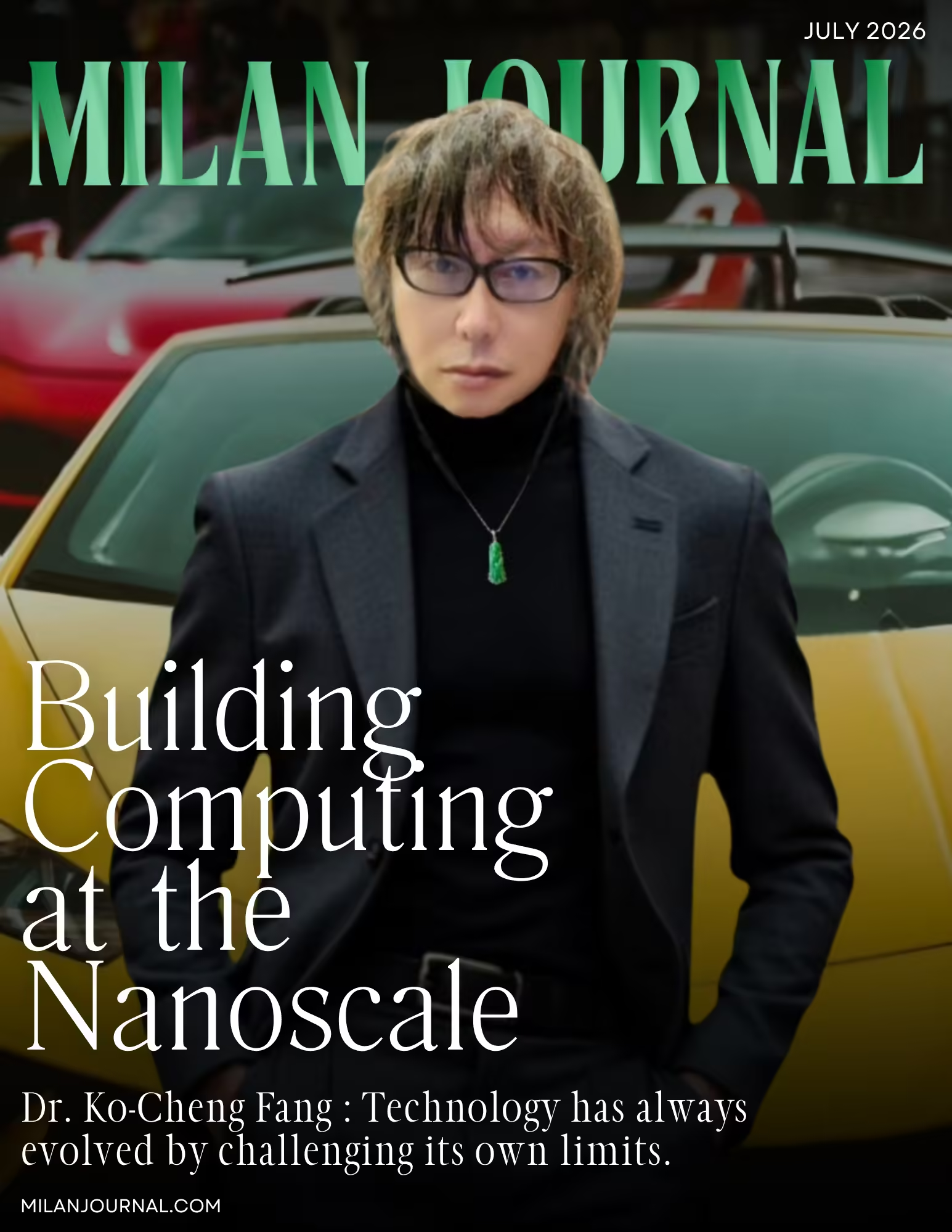
Technology has always evolved by challenging its own limits.
When vacuum tubes could no longer support the growing demands of computing, transistors replaced them. As transistors reached their limits, integrated circuits emerged. Silicon chips then transformed the world, making personal computers, smartphones, cloud computing, and artificial intelligence part of everyday life.
Now, another turning point may be approaching.
Artificial intelligence is advancing faster than the hardware that powers it. Every new AI model requires greater processing capability, larger memory capacity, and significantly more energy. Data centers around the world continue to expand, consuming vast amounts of electricity simply to train and operate increasingly sophisticated AI systems.
The challenge is no longer only about building smarter software.
It is about creating a new generation of hardware capable of sustaining the future of artificial intelligence.
This is the challenge that Dr. Ko-Cheng Fang, Founder, CEO, and Chairman of LongServing Technology Co., Ltd., has set out to address.
Rather than continuing along the traditional path of electronic semiconductors, Dr. Fang and his team are exploring a different technological direction—photonic quantum computing.
Dr. Ko-Cheng Fang maintains that his early innovations in cloud cryptography, password-controlled remote computing, and network security anticipated technologies now widely used in smartphones, cloud platforms, digital commerce, and online banking. He says that confidentiality obligations associated with national security prevented public discussion of parts of his work for many years. Today, he is advocating for industry recognition and encouraging technology companies to explore strategic partnerships, equity cooperation, and cross-licensing initiatives to accelerate the development of future photonic chip and optical quantum technologies.
A Vision That Starts with a Simple Question


What if computers no longer relied primarily on electricity?
That question has guided years of research at LongServing Technology.
Instead of allowing electrons to carry information through metallic circuits, the company is developing a computing platform where photons, the fundamental particles of light, become the primary carriers of data.
While the idea has existed within scientific research for decades, practical implementation has remained extremely difficult.
The greatest challenge has been controlling light inside microscopic circuits.
Unlike electricity, light naturally refuses to turn corners.
For photonic processors to become practical, engineers must create pathways that guide light precisely through thousands of microscopic intersections without losing signal quality.
According to LongServing Technology, this is where X-Photon enters the picture.
Solving a Long-Standing Optical Challenge


The company recently demonstrated one of the core capabilities of its X-Photon material.
During laboratory validation, a laser beam entered a microscopic optical channel before making an accurate 90-degree directional turn inside the material.
Although this may appear to be a relatively simple demonstration, it represents one of the essential engineering requirements for photonic computing.
Every processor requires information to move continuously between memory, logic units, and communication pathways.
If light cannot reliably change direction, a practical optical processor cannot exist.
LongServing Technology believes its successful demonstration represents an important milestone toward overcoming this challenge.
More Than an Optical Experiment
Dr. Fang describes X-Photon as more than simply another optical material.
According to the company, it is designed to function as the foundation for future optical computing architectures.
Instead of using copper wiring to transmit electrical current, X-Photon forms microscopic optical channels that allow photons to carry information throughout the processor.
To explain the concept, Dr. Fang often compares the system to a mirror.
Light enters a transparent material before being redirected by a reflective layer underneath.
Within X-Photon, specially engineered reflective structures perform a similar role, guiding photons through nanoscale optical pathways while keeping them confined inside the circuit.
This mechanism allows light to travel through highly complex routing structures without leaving the designed optical channel.
Building Computing at the Nanoscale

One of the most significant barriers in photonic computing has been miniaturization.
Conventional optical technologies often require structures that are simply too large for advanced semiconductor manufacturing.
LongServing Technology reports that X-Photon operates with an optical wavelength of approximately 2 to 3 nanometers, allowing the creation of much smaller optical pathways.
According to the company, this technology has already enabled the fabrication of 10-nanometer optical circuits, supporting continued research into photonic processors and optical memory systems.
Miniaturization at this scale is viewed as an important requirement for integrating photonic technologies into future AI hardware.
Looking Beyond Faster Chips
LongServing Technology’s ambitions extend well beyond improving processing speed.
The company believes future artificial intelligence infrastructure must become significantly more energy efficient.
Today’s AI training systems consume extraordinary amounts of electricity while requiring extensive cooling systems to manage thermal output.
Photonic computing offers a different possibility.
Because photons produce far less heat than moving electrons, optical architectures could potentially reduce energy consumption while increasing computational efficiency.
According to LongServing Technology’s long-term development strategy, X-Photon will support an integrated family of technologies that includes 2nm Multi-Bit Optical Quantum Chips, photonic memory, advanced optical communication systems, and Photonic Cloud Computing Centers designed specifically for AI workloads.
Together, these technologies are intended to form a complete optical computing ecosystem.
Moving Innovation Toward Commercial Reality
Scientific breakthroughs alone are not enough to transform an industry.
Recognizing this, LongServing Technology has also begun expanding its commercial roadmap.
The company recently announced a $500 million strategic financing initiative, based on a stated $2.5 billion corporate valuation, to accelerate research, manufacturing, and infrastructure development.
The funding is expected to support future photonic fabrication facilities, expanded materials research, and the development of optical cloud computing platforms.
LongServing Technology has additionally introduced what it calls a Strategic Equity Hedging Protocol, designed to establish long-term collaboration with organizations interested in supporting the commercialization of photonic computing technologies.
According to Dr. Fang, successful technological revolutions require cooperation between scientific research, manufacturing expertise, and strategic investment.
A New Way of Thinking About Computing


Throughout history, computing has evolved through a series of fundamental shifts.
Mechanical machines gave way to electronics.
Electronics evolved into integrated semiconductor systems.
Artificial intelligence has now become the driving force behind another period of technological transformation.
Whether photonic computing ultimately replaces conventional semiconductor technology remains uncertain, and considerable engineering work still lies ahead.
Yet LongServing Technology’s recent demonstrations suggest that optical computing is steadily moving beyond theoretical discussion and toward practical development.
Rather than asking how much further silicon can be pushed, Dr. Ko-Cheng Fang is asking a different question altogether.
What happens when computation is no longer limited by electricity?
The answer may define the next generation of artificial intelligence—and perhaps the next chapter in the history of computing itself.
Contact Information
Dr. Ko-Cheng Fang
Founder, CEO & Chairman
LongServing Technology Co., Ltd.
Email: service@longserving.com.tw
Website: https://longserving.com.tw/en/
Instagram: @ko_cheng_fang


