






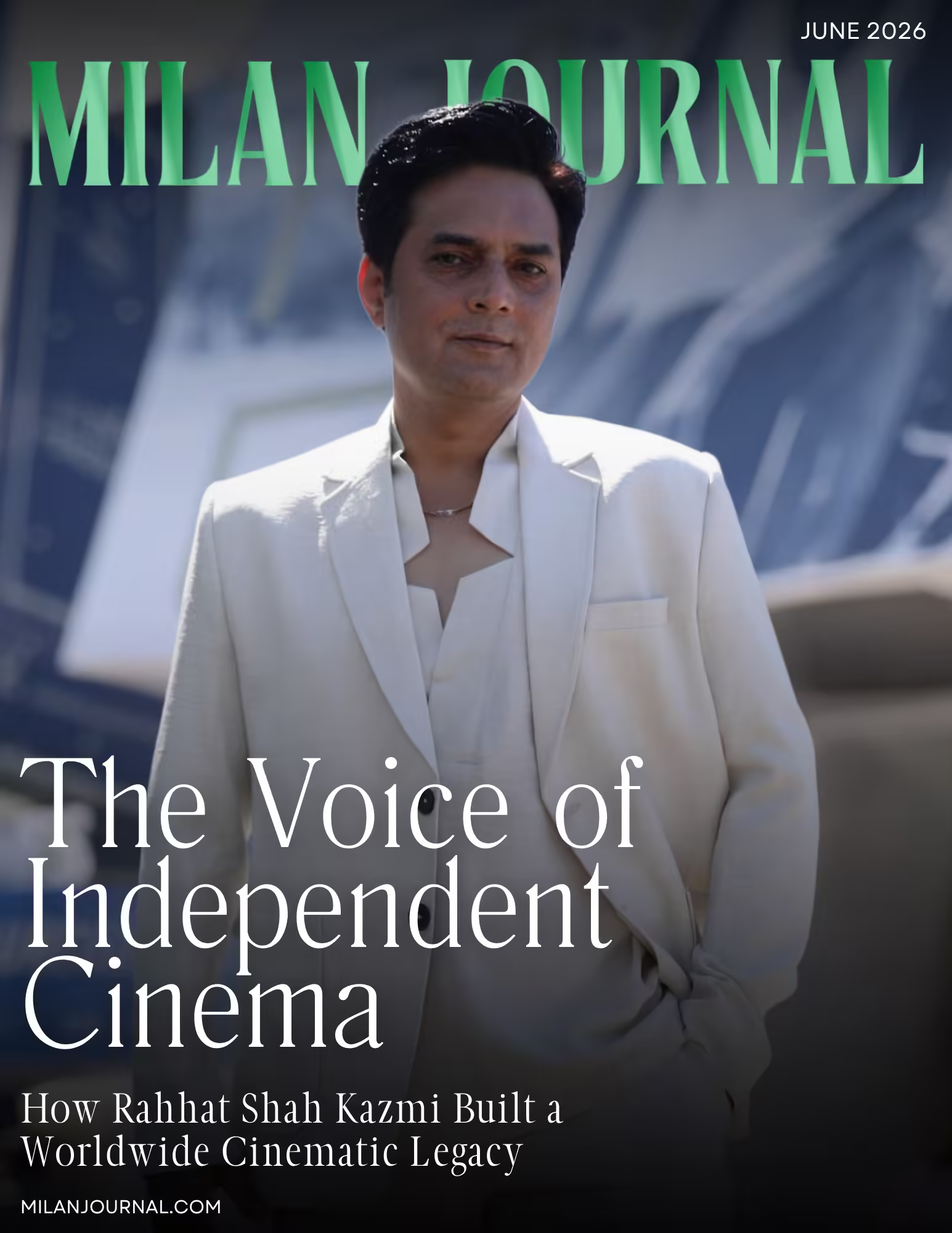
How Rahhat Shah Kazmi Quietly Became One of India’s Most Internationally Celebrated Filmmakers
There is something distinctly uncommon about Rahhat Shah Kazmi.
In an industry where visibility often defines success, he built a career by focusing on something far more enduring than fame. While many pursued box office numbers, celebrity culture, and constant media attention, Kazmi dedicated himself to the art of storytelling.
Today, that commitment has brought him to a remarkable moment in his journey.
Following the sold out world premiere of Bombay Stories at the Cannes Film Festival and its subsequent victory for Best Feature Film at the Paris Film Awards, Rahhat Shah Kazmi stands among the most respected independent filmmakers representing India on the global stage. Yet his story is not one of overnight success. It is a story shaped by persistence, vision, and an unwavering belief in the power of human narratives.
From Kashmir to Cinema


Long before international acclaim, film festivals, and global collaborations became part of his life, Rahhat Shah Kazmi was simply a young man from Jammu and Kashmir who loved stories.
He was fascinated by people and their experiences. Stories of resilience during difficult times. Stories of love, longing, hope, and survival. Stories that revealed the complexity of human emotions.
These themes would later become the foundation of his work as a filmmaker.
Unlike directors who become associated with a particular genre, Kazmi became known for something deeper. His films consistently explore the emotional realities of ordinary people. Whether addressing social issues, personal relationships, political circumstances, or cultural transformations, his focus has always remained on the human experience.
That approach has defined his work for nearly two decades.
Building a Creative Home
The path to becoming a filmmaker was far from easy.
Independent cinema rarely offers certainty. Resources are limited, opportunities are unpredictable, and recognition often comes slowly. Yet rather than allowing these challenges to discourage him, Kazmi saw them as opportunities to create something different.
He believed that meaningful stories could travel across borders regardless of budget.
That belief eventually led to the creation of Rahhat Kazmi Film Studios, widely known as RKFS.
What began as a production company soon evolved into a creative platform dedicated to ambitious and meaningful storytelling. Through RKFS, Kazmi gained the freedom to develop projects that may never have found a place within conventional commercial frameworks.
The studio became more than a business. It became a creative ecosystem where ideas could grow and where stories could be told without compromise.
The Strength Behind the Vision

Every great journey is supported by people who share the vision.
For Rahhat Shah Kazmi, one of the most important figures in that journey has been his wife and creative partner, Asiya Kazmi.
Over the years, industry colleagues and collaborators have frequently described Asiya as the emotional and strategic backbone of RKFS. Through uncertain productions, international negotiations, creative challenges, and moments of doubt, she remained a constant source of support and strength.
Together, they transformed a dream into a globally recognized creative enterprise.
Their partnership reflects a rare commitment to building something meaningful and lasting. Rather than chasing trends, they focused on creating a legacy rooted in artistic integrity and cultural impact.
Stories That Cross Borders
Kazmi’s breakthrough arrived with Identity Card, a film that attracted international attention and was eventually screened at the European Parliament.
The project showcased his ability to address socially significant themes while maintaining a deeply personal and human perspective.
It was an early indication of the filmmaker he would become.
He followed this success with Mantostaan, inspired by the writings of the legendary author Saadat Hasan Manto. Through interconnected narratives, the film explored the emotional consequences of Partition, focusing not on historical spectacle but on the individuals whose lives were forever changed.
The film resonated with audiences around the world and further established Kazmi as a filmmaker willing to engage with history through empathy and nuance.
Literature as Inspiration
One of the defining characteristics of Rahhat Shah Kazmi’s career has been his relationship with literature.
His acclaimed film Lihaaf, adapted from the celebrated work of Ismat Chughtai, demonstrated his ability to bring literary classics to contemporary audiences while preserving their emotional and cultural depth.
The film earned multiple international awards and reinforced his reputation as a filmmaker capable of translating complex literary works into compelling cinematic experiences.
For Kazmi, literature has never been merely a source of stories.
It has been a dialogue across generations. A way of understanding society. A bridge connecting past experiences with present realities.
That literary influence continues to shape much of his work today.
Expanding the Horizon

As his career evolved, so did the scope of his projects.
Films such as Lines, Am I Next, Last Coffee, Wishlist, and The Doorman showcased his versatility as a storyteller while maintaining his commitment to emotionally driven narratives.
Each project explored different dimensions of human experience, reflecting his willingness to experiment while remaining true to his artistic voice.
Then came one of the most significant milestones of his career.
Country of Blind gained international recognition not only for its storytelling but also because its screenplay was acquired by the Academy Library in Los Angeles.
For any filmmaker, inclusion within one of the world’s most respected cinematic archives is an extraordinary achievement. For an independent filmmaker working outside mainstream systems, it represented a remarkable validation of years of dedication and perseverance.
Creating International Cinema
Despite growing recognition, Kazmi never allowed himself to become comfortable.
He continued exploring new creative territories and building relationships across countries and cultures.
This vision reached a new level with Love in Vietnam.
The film became a landmark collaboration between India and Vietnam, demonstrating the possibilities of international co production and cultural exchange. The project earned widespread appreciation and secured Kazmi the Best Director of Asia honor at the Seoul Global Movie Awards, while the film itself received the award for Best Asian Film.
The success confirmed what many had already begun to recognize.
Rahhat Shah Kazmi was no longer simply an Indian filmmaker. He had become a truly international cinematic voice.
The Triumph of Bombay Stories

If previous films expanded his reputation, Bombay Stories elevated it.
Inspired by the fearless writings of Saadat Hasan Manto, the film explores loneliness, desire, dignity, and emotional survival within contemporary Mumbai.
Rather than adapting Manto directly, Kazmi reinterpreted the author’s timeless themes for a modern audience. The result is a film that feels both deeply rooted in literary tradition and strikingly relevant to contemporary life.
The project brought together an accomplished international team.
Produced by Rahhat Shah Kazmi, Tariq Khan, and Zeba Sajid, the film also featured collaborations with Sonali Doshi, Gargi Duggal, Monica Aggarwal, and Tahir Ashraf. Developed in association with Alphaa Productions and Mango Tree Entertainment India, the production reflected the increasingly global outlook of RKFS.
The cast, led by Mouni Roy, Anupriya Goenka, and Sushmita Singh, delivered performances that brought emotional authenticity and depth to the film’s narrative.
A Defining Cannes Moment
The Cannes Film Festival premiere marked a turning point.
Audiences gathered outside the venue long before the screening began. The theater was filled to capacity, and viewers remained fully engaged throughout the film.
As the credits rolled, conversations continued among festival attendees, critics, and industry professionals.
Many described Bombay Stories as one of the most emotionally powerful Indian films showcased during the festival.
For Kazmi, the response carried special significance.
The moment was not about glamour or prestige. It was about connection. It was about seeing audiences from different cultures respond to universal human experiences.
That reaction validated everything he had worked toward throughout his career.
Recognition Beyond Cannes
The celebrations did not end there.
Soon after its successful premiere, Bombay Stories was awarded Best Feature Film at the Paris Film Awards.
The recognition transformed a successful festival debut into a major international achievement and further solidified Kazmi’s reputation among global filmmakers.
Yet perhaps the most remarkable aspect of his journey is not the awards themselves.
It is the consistency of purpose that has guided every chapter of his career.
For nearly twenty years, Rahhat Shah Kazmi has remained committed to a simple but powerful belief.
That stories matter.
That literature matters.
That empathy matters.
And that cinema can still serve as a bridge connecting people, cultures, and experiences across the world.
A Legacy Still Being Written
Today, as RKFS continues to expand its international slate and develop projects across multiple countries, Rahhat Shah Kazmi occupies a unique space within contemporary cinema.
He is neither a conventional commercial filmmaker nor a traditional festival auteur.
Instead, he has created his own path.
A path built on persistence, collaboration, artistic courage, and emotional truth.
From the valleys of Kashmir to the red carpets of Cannes, from literary inspiration to international recognition, his journey stands as a testament to what can happen when a storyteller remains faithful to the stories that matter most.
Rahhat Shah Kazmi’s life has always been shaped by stories.
Today, the world is finally listening.


