







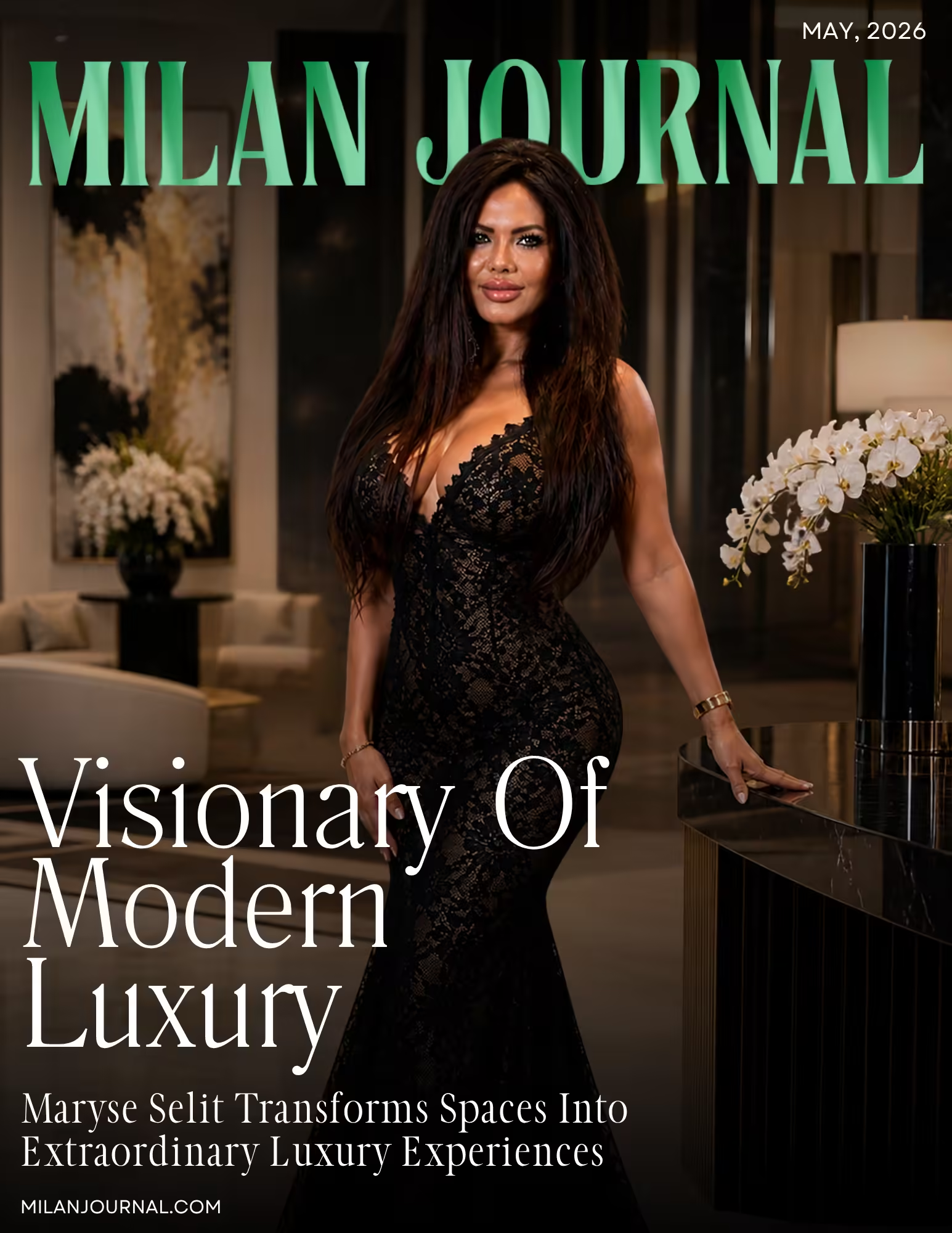
In an era that rewarded specialization, Maryse Selit built a life—and a business—on expansion. Attorney. Model. Singer. Legal podcaster. Abstract artist. Entrepreneur. Each identity is fully formed, yet none exists in isolation. Together, they form the blueprint of a woman who refuses to be reduced.


But it is within the world of luxury hospitality that Selit’s vision became most tangible—where instinct, design, and audacity converged into something quietly extraordinary.
A PORTFOLIO OF PLACES—AND PRESENCE

Selit didn’t just invest in real estate. She curated experiences.
Each property in her portfolio was more than a structure; it’s a point of view—an immersive environment shaped entirely by her hand. She sourced the properties herself, negotiated the acquisitions, and transformed them with an eye that blended refinement with emotional impact.
At Central Park West in New York City, one of her most coveted residences, overlooks the expanse of the park in a way that feels almost cinematic. Floor-to-ceiling windows frame sweeping, uninterrupted views of green canopy and skyline—a living painting that shifts with the light. Inside, the space is curated with a restraint that allows the view to speak, yet every detail—from texture to tone—is unmistakably Selit. This is not just a Manhattan address. It is a vantage point.
WHERE WATER MEETS DESIGN

Further south, in Cape May, New Jersey, Selit created something entirely different—yet equally singular.
Her waterfront property is defined by immersion. From nearly every angle, the home opens to sweeping views of the water—endless, reflective, hypnotic. Here, architecture dissolves into landscape. Walls give way to horizon.
The outdoor experience is nothing short of transportive: a 40-foot swimming poolstretches toward the water’s edge, creating the illusion of infinity, while a 20-person swim spa invites both leisure and spectacle. It is a setting designed not just for relaxation, but for presence—for the kind of stillness that only vast, uninterrupted views and the most remarkable sunsets, can evoke.
Guests often describe the property as one of the most visually arresting environments they have ever encountered. Not because of excess—but because of clarity. Space. Perspective.
EATON HOUSE: HISTORY, REIMAGINED

In Watchung, New Jersey, Selit turned her attention to something altogether different: legacy.
The historic Eaton House stands as a testament to another era—rich in architectural detail, layered with history. Once home to Sir Aubrey Eaton, a Congressman and drafter of the United Nations Declaration, the residence carries with it a sense of gravity and permanence.
Selit approached it not as a relic, but as a living narrative. The home features five wood-burning fireplaces, each anchoring a different space with warmth and character. Original details—moldings, finishes, structural nuances—have been preserved and elevated, allowing the house to retain its historical integrity while quietly integrating Selit’s modern sensibility.
It is a rare balance: reverence without rigidity.

Where her coastal and city properties emphasize openness and light, Eaton House is about depth. Texture. Story. It invites a slower kind of luxury—one rooted in time rather than trend.
A VERTICAL VISION: THE ASIAN PROPERTY
Beyond the United States, Selit’s ambition took on an even more architectural dimension with her purchase of a five-story property in Asia—a project that underscored not just her design sensibility, but her willingness to build from the inside out.
This was not a simple acquisition. It was a transformation in progress. Rising vertically, the home reflects a different kind of luxury—one shaped by structure, engineering, and spatial choreography, and an elevator connecting all five floors.
DESIGN ON A DIME—IMPACT WITHOUT EXCESS

Perhaps the most compelling aspect of Selit’s portfolio is not the locations or the clientele—but the process.
She interior designed each home herself. No sprawling budgets. No reliance on high-profile design firms. Instead, she worked with constraint—and turned it into an advantage. Her philosophy is deceptively simple: luxury is not about cost; it is about cohesion.
Every space reflects a deliberate interplay of materials, light, and proportion. Nothing feels accidental. Nothing feels overworked. And then there is her art—bold, abstract, unmistakably hers—featured throughout each property as both focal point and signature.
Guests don’t just notice the design. They feel it.
THE CLIENTELE—AND THE QUIET POWER OF DISCRETION

Selit’s properties drew a clientele as discerning as the spaces themselves.
From acclaimed comedian Katt Williams to music legend Chaka Khan, as well as elite race car drivers, PGA golfers, and other high-profile figures, her homes have become sought-after sanctuaries for those accustomed to the best.
They come not only for privacy—but for atmosphere. And they pay accordingly. Selit’s properties commanded up to $50,000 per week, a figure that reflects not just luxury, but distinction. In a market saturated with high-end offerings, her homes stood apart because they were not designed by committee. They were authored.
THE THROUGHLINE: A WOMAN WHO BUILDS

It would be easy to view this success as a departure from Selit’s other identities—but it is, in fact, an extension of them.
The precision of law informs her negotiations. The sensibility of a model informs her visual composition. The rhythm of a singer shapes her understanding of flow and space. The introspection of an artist defines her aesthetic. The clarity of a podcaster sharpens her voice.
Everything connects.
What emerges is not a collection of pursuits, but a unified philosophy: that power lies in integration.
REDEFINING WHAT POWER LOOKS LIKE

Maryse Selit did not follow a blueprint. She created one.
She entered industries that rarely intersect—and made them speak to each other. She built a multi-million dollar hospitality business not by replicating what already existed, but by trusting what she saw before anyone else did.
Her properties were not just places to stay. They are expressions of authorship. Of independence. Of a woman who understands that true luxury is not inherited—it is imagined, constructed, and claimed.
And perhaps that is her most compelling achievement.
Not the homes. Not the clientele. Not even the numbers.
But the fact that every inch of it—every wall, every canvas, every view—began as an idea she refused to ignore.


