

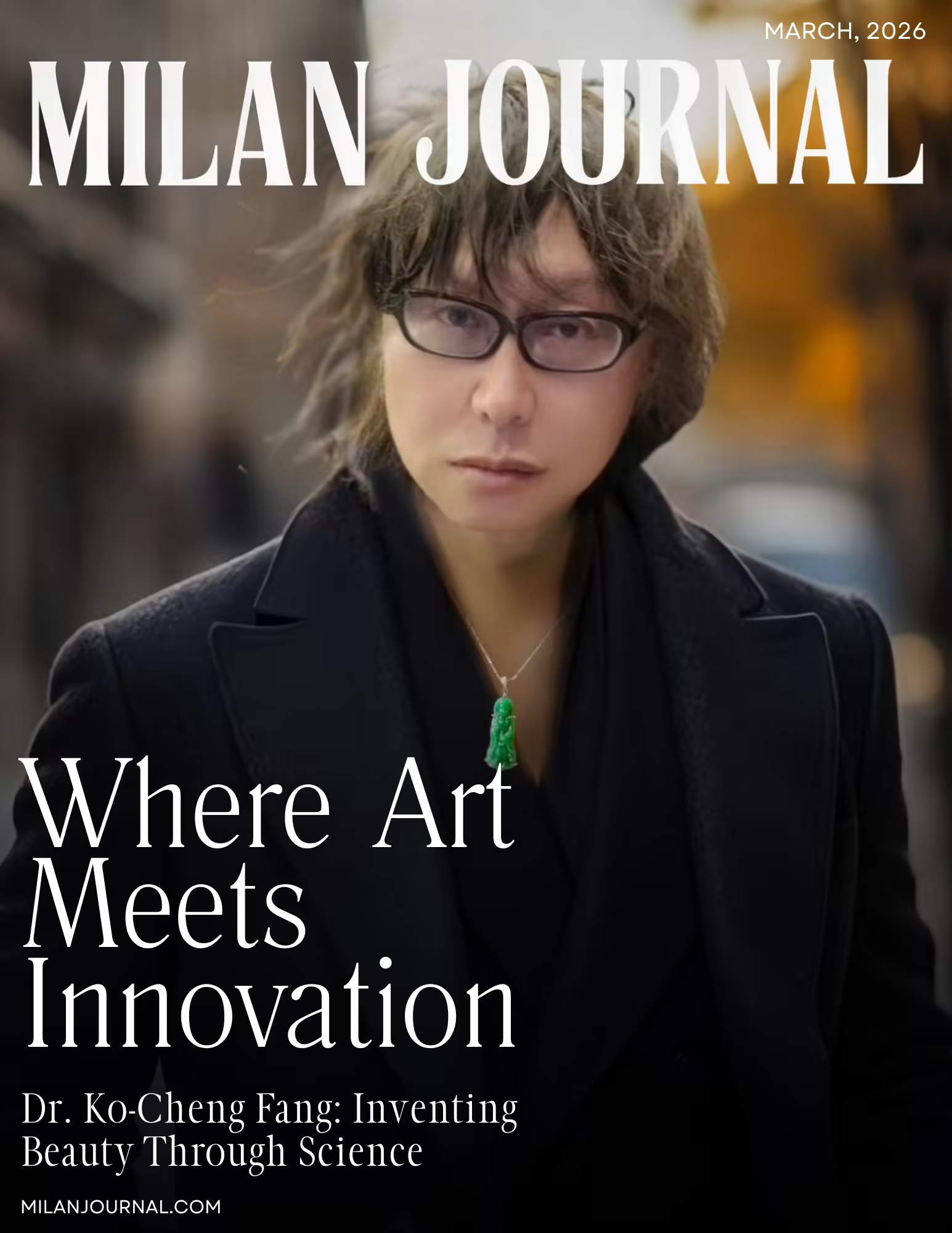
In an era where specialization often defines success, Dr. Ko-Cheng Fang stands apart as a rare polymath whose work bridges art, science, and technological innovation. As the Founder, Chairman, and CEO of LongServing Technology Co., Ltd. in Taipei, Taiwan, Dr. Fang has cultivated a career that defies traditional boundaries. Inventor, artist, entrepreneur, and visionary, his journey reflects a philosophy that creativity and scientific discovery are not opposing forces, but complementary expressions of the same curiosity.
For Dr. Fang, innovation begins with imagination. Long before he became known for technological breakthroughs, he was first an artist—an observer of the world who sought meaning through form, expression, and emotion.
The Artist Before the Innovator

Dr. Fang’s creative instincts emerged remarkably early. Even before entering elementary school, he displayed an intense fascination with drawing. Hours would pass as he studied shapes, shadows, and the subtleties of expression, often filling pages with sketches that reflected both precision and imagination.
His early influences came from diverse artistic traditions. Surrounded by books featuring Western classical paintings and Eastern artistic techniques, he immersed himself in both worlds. Chinese gongbi painting, known for its delicate detail and discipline, fascinated him. At the same time, Western oil painting captivated him with its dramatic use of light, texture, and emotional depth.
Among all subjects, the human face intrigued him most.
Rather than simply sketching appearances, Dr. Fang began studying human anatomy and facial structure, attempting to understand how emotion and personality are revealed through subtle features. For him, portraiture was never about copying reality—it was about capturing something deeper.
He often described this approach as revealing “the soul behind the eyes.”
Over time, Dr. Fang developed an extraordinary visual memory. After seeing a face briefly, he could later recall and recreate its details with remarkable accuracy. Whether drawing people or animals—particularly dogs—his goal was always the same: to express character and inner presence rather than simply replicate form.
This artistic discipline shaped the way he saw the world. It trained him to observe details, imagine possibilities, and approach problems creatively—skills that would later become essential in his scientific work.
When Creativity Meets Technology
For Dr. Fang, science was never separate from art. Instead, it became another medium through which creativity could be expressed.
During the early days of modern computing, he turned his attention to a problem that frustrated both developers and users: the vulnerability of software systems. Crashes, corrupted files, and security threats were becoming increasingly common as digital infrastructure expanded.
Rather than accepting these challenges as inevitable, Dr. Fang began exploring new approaches to digital protection.
His solution involved combining cloud-based storage systems with secure
password-lock frameworks, creating an architecture capable of automatically restoring corrupted programs while simultaneously detecting suspicious activity through cloud monitoring. The concept—patented in the early 2000s—introduced a proactive model for cybersecurity, emphasizing resilience and automated recovery.
This approach anticipated many principles that later became foundational in modern cloud computing and smartphone security.
According to Dr. Fang, elements of this architecture were eventually adopted by the U.S. Department of Homeland Security, strengthening digital defense systems during a time when cyber threats were rapidly evolving.
But for Dr. Fang, solving one problem simply opens the door to the next challenge.
Reinventing One of Nature’s Rarest Gems

One of his most fascinating scientific pursuits centers on Imperial Green jadeite, one of the rarest and most valuable gemstones in the world.
For centuries, jadeite has been deeply connected to cultural heritage across Asia, symbolizing purity, longevity, and prosperity. Yet high-quality jadeite deposits are extremely rare, making the gemstone increasingly difficult to obtain.
Dr. Fang approached the problem not only as a scientist but also as an artist determined to preserve beauty.
Through extensive research in gemology, geology, chemistry, and materials science, he conducted thousands of experiments to understand the crystal structure responsible for jadeite’s luminous green translucence.
After years of experimentation, he achieved a remarkable milestone: the successful
laboratory creation of gem-grade jadeite.
For Dr. Fang, the breakthrough represented more than a scientific achievement. It was a way to ensure that the beauty and cultural significance of jadeite could continue without relying solely on limited natural resources.
In 2026, this innovation entered the world of luxury design through LongServing Technology’s jadeite handbag collection.
These handbags integrate laboratory-grown jadeite gemstones directly into their structure, combining scientific craftsmanship with contemporary fashion design. Each gemstone undergoes extreme heat and pressure—exceeding 1,400 degrees Celsius—to form crystals with the vivid color and translucence associated with natural jadeite.
The result is a striking fusion of Eastern gemstone heritage and modern luxury artistry.
The Future: Photonic Quantum Computing

Yet Dr. Fang’s ambitions extend far beyond gemstones and cybersecurity.
As artificial intelligence continues to transform industries worldwide, conventional semiconductor technologies are approaching physical limits. Data centers consume vast amounts of energy, and the pace of chip miniaturization—once driven by Moore’s Law—is slowing.
Dr. Fang believes the next technological revolution may come from photonic quantum computing.
Unlike traditional processors that rely on electrons to carry information, photonic chips use light particles, or photons, to transmit and process data. In theory, these systems could operate thousands of times faster than electronic processors while dramatically reducing energy consumption.
Central to this research is a novel material Dr. Fang calls X-Photon, engineered to emit ultra-short-wavelength light capable of operating at the nanoscale dimensions required for advanced chip architectures.
If successfully commercialized, such technology could transform fields ranging from artificial intelligence and robotics to aerospace engineering and medical diagnostics.
Innovation Guided by Philosophy
Despite working at the cutting edge of science and technology, Dr. Fang’s philosophy remains deeply rooted in introspection.
He practices Zen meditation, believing that moments of stillness sharpen intuition and unlock creative insight.
For him, invention is not purely technical—it is a deeply human process that balances logic with imagination.
Looking back on decades of experimentation, Dr. Fang does not measure success by individual breakthroughs. Instead, he views every attempt—successful or not—as part of a continuous journey of exploration.
Through LongServing Technology, he continues to explore the powerful intersection of art, science, and innovation.
For Dr. Ko-Cheng Fang, the convergence of creativity and technology is not unusual—it is essential. It is the path through which ideas become reality—and through which the future is imagined, engineered, and brought to life.